Electric Surfboard vs eFoil Board vs Jetboard: What Is the Difference?
Compare an electric surfboard, eFoil board, electric foil board, eFoil surfboard, motorized surfboard, and jetboard by speed, learning curve, riding style, and maintenance.
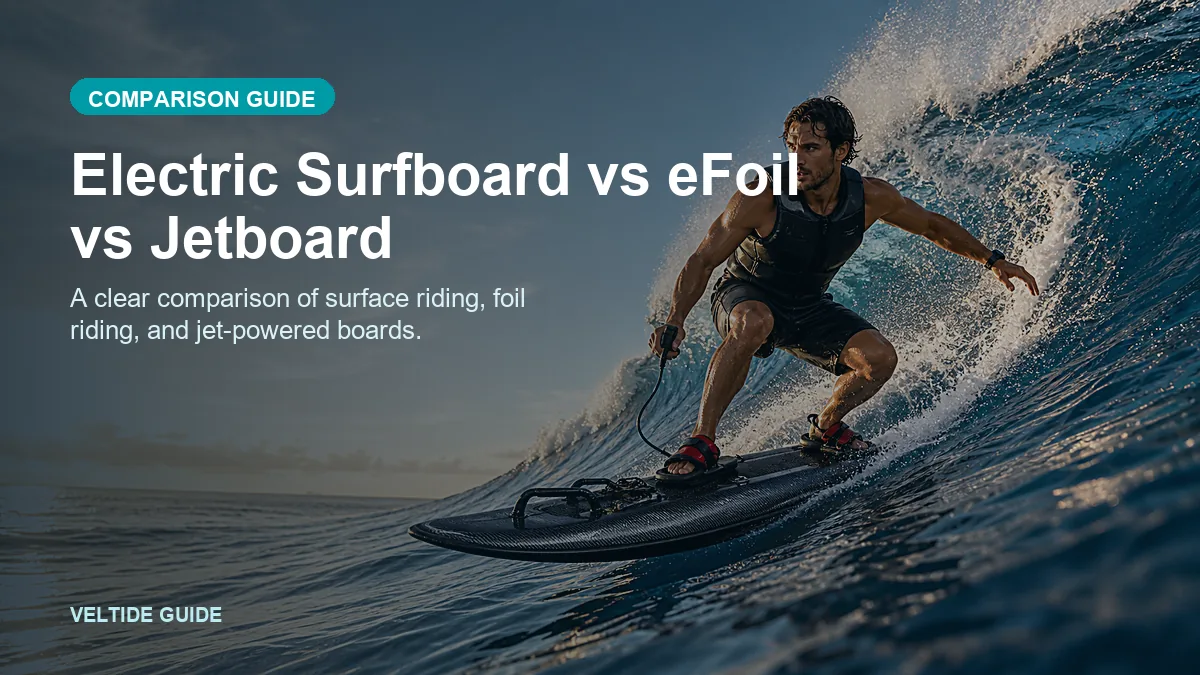
Electric water sports have grown quickly, and the names can be confusing. Electric surfboard, eFoil, jetboard, motorized surfboard, powered surfboard, and electric hydrofoil are often used in similar conversations, but they are not always the same product.
You may also see search terms such as electric surf board, eFoil board, electric foil board, and eFoil surfboard. This guide explains how those terms fit together and which type of product may be best for your riding style.
If you are shopping for your first electric watercraft, understanding the difference will help you choose the right ride.
Quick Definitions
Electric Surfboard
An electric surfboard is a powered board with an electric motor and battery. It moves across the surface of the water and usually uses jet propulsion. It does not need waves.
Jetboard
A jetboard is a type of electric surfboard that uses a jet propulsion system. Many people use the words electric surfboard and jetboard interchangeably.
eFoil
An eFoil, eFoil board, electric foil board, or eFoil surfboard is an electric hydrofoil board. It has a mast and wing under the board. Once it gains speed, the board lifts above the water and rides on the foil.
Main Difference in Riding Feel
An electric surfboard rides on the surface of the water. It feels fast, direct, and close to the wave or water surface. It is often more similar to surfing, wakeboarding, or riding a personal watercraft.
An eFoil lifts above the water. It feels smoother and quieter because the board is not constantly hitting the surface. The sensation is more like flying above the water.
If you want aggressive carving, spray, speed, and a more familiar board-sport feeling, an electric surfboard may be the better choice. If you want a floating, silent, flight-like experience, an eFoil may appeal more.
Speed Comparison
Electric surfboards and jetboards are often built for strong acceleration and surface speed. Since they stay on the water surface, they can feel powerful and sporty.
eFoils can also be fast, but many riders focus more on smooth cruising than maximum speed. The foil creates lift, which changes the way speed feels.
For riders who want a dramatic, high-energy ride, electric surfboards often feel more exciting. For riders who want a smooth and technical ride, eFoils are very appealing.
Learning Curve
Electric surfboards can be easier for many beginners because the board stays on the water surface. A stable board with smooth throttle control can help new riders stand and ride faster.
eFoils require learning both board balance and foil control. When the board lifts, small body movements have a bigger effect. This makes eFoiling rewarding, but it can take more practice.
In general:
- Electric surfboards are often easier to understand at first
- eFoils may require more patience and balance
- Jetboards are often better for riders who want speed quickly
- eFoils are often better for riders who enjoy technical progression
Water Conditions
Electric surfboards can work well on lakes, rivers, bays, and coastal water when conditions are suitable. They can handle small chop better than many people expect, depending on hull design and rider skill.
eFoils work best in areas with enough depth for the mast and foil. Shallow water, weeds, rocks, and debris can be more problematic because the foil system extends below the board.
Before choosing either option, consider:
- Water depth
- Local rules
- Boat traffic
- Wind conditions
- Launch areas
- Storage and transport
Portability and Storage
Electric surfboards are large, but they are generally one main board plus battery and accessories.
eFoils include the board, mast, wings, fuselage, battery, and remote. Some parts may need assembly and careful handling.
If you want simpler setup, an electric surfboard may feel more straightforward. If you do not mind assembling and tuning components, an eFoil can be a very rewarding product.
Maintenance
Both electric surfboards and eFoils require proper battery care, fresh-water rinsing, connector inspection, and safe storage.
Electric surfboards require attention to the jet intake, hull, seals, straps, remote, and battery system.
eFoils require attention to the foil assembly, mast, wing connections, screws, board, battery, and remote.
Salt water riders should be especially careful with rinsing and drying after every session.
Which One Is Better for Beginners?
There is no single answer, but many first-time riders find electric surfboards easier to approach. The board stays on the surface, the stance feels familiar, and the riding style can be learned gradually.
An eFoil can be beginner-friendly with the right instruction, but the lift phase adds another learning step.
If your goal is to get moving quickly, choose a stable electric surfboard. If your goal is to master a unique floating sensation, consider an eFoil.
Which One Is Better for Resorts and Rentals?
For rental businesses, resorts, and water sport centers, electric surfboards can be attractive because they are easier to explain, visually exciting, and often suitable for short guided sessions.
However, the right choice depends on staff training, local water conditions, safety rules, maintenance capacity, and customer profile.
For any commercial use, clear safety procedures and local compliance are essential.
Final Recommendation
Choose an electric surfboard or jetboard if you want:
- Strong acceleration
- Surface riding
- A sporty watercraft feeling
- Easier first-session learning
- A compact alternative to gas-powered watercraft
Choose an eFoil if you want:
- A smooth flying sensation
- Technical progression
- Quiet cruising
- A different kind of balance challenge
- Efficient riding above the water
Both are exciting. The right choice depends on the experience you want.
FAQ
Is a jetboard the same as an electric surfboard?
Often, yes. A jetboard is usually an electric surfboard that uses jet propulsion. Some brands use the terms differently, so it is always worth checking the propulsion system.
What is an electric foil board?
An electric foil board is another name for an eFoil board. It uses an electric motor and underwater foil system to lift the rider above the water surface.
Is an eFoil harder than an electric surfboard?
For many beginners, yes. An eFoil adds the challenge of controlling lift above the water, while an electric surfboard stays on the surface.
Which is faster, an electric surfboard or an eFoil?
It depends on the model, battery, motor, rider weight, and water conditions. Electric surfboards often feel more aggressive because they ride directly on the water surface.
Can I ride an electric surfboard without waves?
Yes. Electric surfboards are powered, so they do not require waves.
Which is better for shallow water?
Electric surfboards are often more practical in shallow areas than eFoils because they do not have a long mast and foil below the board. Always follow the product’s minimum-depth guidance.